
A testable question about meditation
A preprint by Jian Wang and colleagues, submitted on 29 October 2026, asks whether fMRI patterns can distinguish groups of self-reported jhāna stages. We checked version 1 of ACAM-J-MARS. Its value for readers is a concrete evaluation problem, not a test of enlightenment. We have not verified a peer-reviewed publication of this version. [1]
Here, jhāna means states of meditative absorption that participants identify using labels J1–J8; the middle group is J3–J5. Functional magnetic resonance imaging (fMRI) measures blood-oxygenation changes associated with brain activity. Connections here are statistical relationships between signals, not a map of anatomical fibres. [2]
Count people as well as recordings
The study reports 204 segments from 22 practitioners. It combines connectivity across brain regions with features of slow signal fluctuations. Training and testing use different participants. That separation helps examine transfer between people, but repeated recordings do not turn 22 people into 204 independent participants. [2]
Read the task beside the score
Tables 1–2 report balanced accuracy of 0.757 for early (J1–J2) versus late (J6–J8) stages, and 0.545 for early/middle/late groups. Balanced accuracy averages the proportion correctly identified within each class. These are different classification tasks. Neither number is the probability that a particular person has attained jhāna, nor a rating of the quality of their practice. [2] [3]
A new participant still needs several recordings
The method removes each participant’s average feature pattern using multiple recordings. The paper explicitly requires several runs for an unseen participant. Labels are self-reported, the cohort is small, and independent validation is still needed. This does not establish a ready-to-use, single-recording or real-time detector. [2]
Keep an unresolved number visible
Figure 1 gives the nearest-class-mean classifier a balanced accuracy of 0.745; Tables 1–2 give 0.757. We verified both in the PDF. The inspected paper does not clearly reconcile them. We cite the table values with this qualification rather than silently choosing a corrected value. [2]
A reading exercise, not a meditation test
For your next paper, make four columns: the question, the labels, the people kept out of training, and the information needed from a new person. Add the exact table, metric and comparison group beside every performance claim. Ask what evidence would change your interpretation.
Then separate three statements: a model predicts a recorded label; that label faithfully describes an experience; the experience has a particular meaning within a tradition. Evidence for the first does not settle the other two. This worksheet is an editorial reading aid, not a clinical tool or a way to rank practitioners.
What we checked
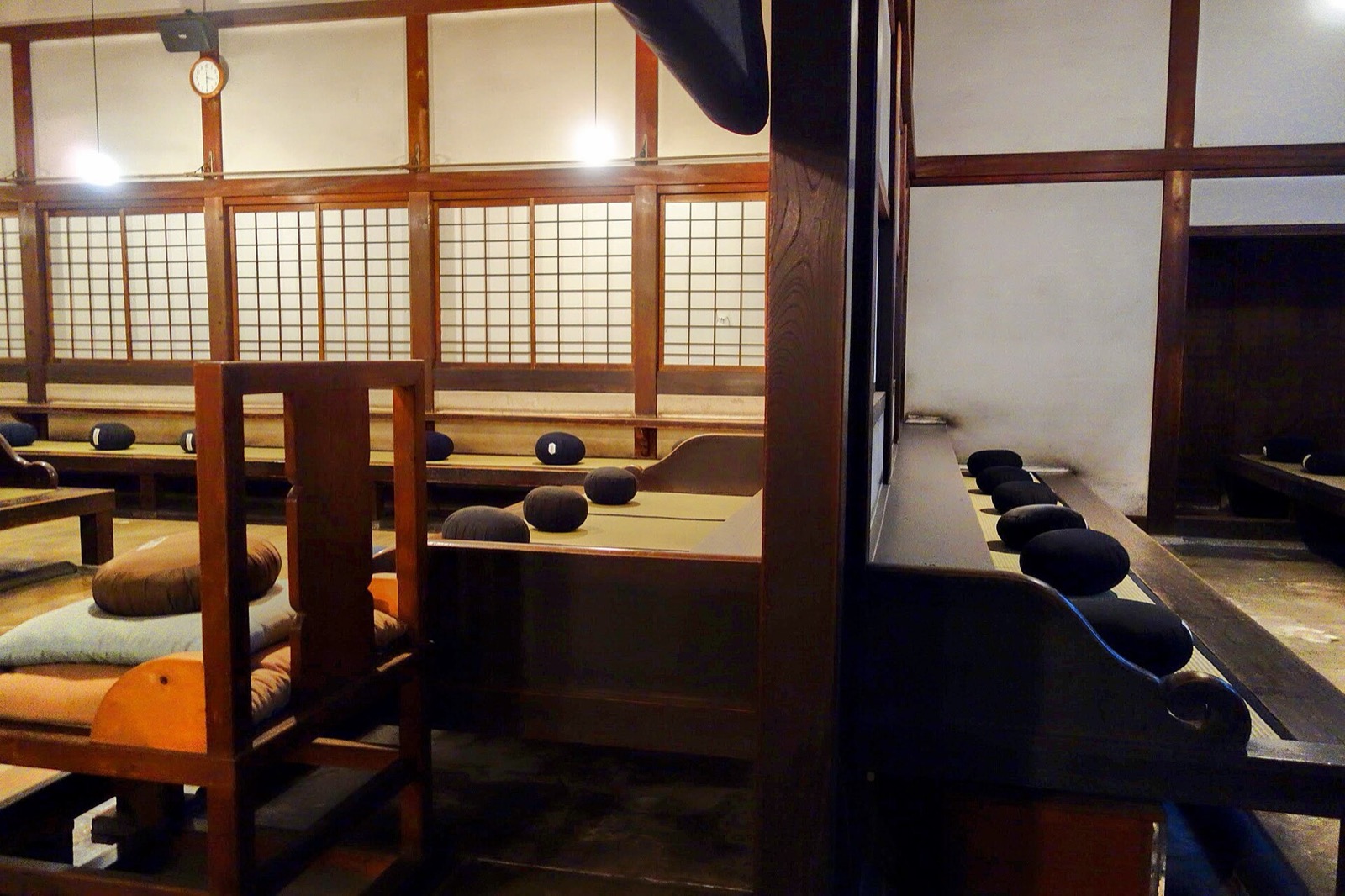
We read the preprint and inspected its PDF tables and figures; we did not reproduce the experiments. The paper offers code on request. Research used Maximus with Nemotron reasoning; drafting and comparison of all 13 language versions used AI. Specialist language review remains pending. The photograph shows a meditation hall, not the study’s participants or experimental site. [2]