Independent, non-commercial initiativeVarna, Bulgaria · Founded in 2026
MATREYA

Institute for Buddhism, Science & Artificial Intelligence

Wisdom · Inquiry · Compassion
For the benefit ofall living beings
English

MATREYA · Projects · Aims

Projects and aims of the institute

What we do and why

Matreya brings Buddhist texts, contemporary science and artificial intelligence together to ask questions that neither side could ask alone. We publish research articles with primary sources, build open tools and invite everyone to check our work.

Each programme below states its question, its current status and what remains open. A question is not yet a conclusion: we keep metaphor apart from claims that can be tested, and we correct ourselves in public.

Programmes

Programme 01 · Lab of worlds

Simsara: a world to observe

Status: Open prototype in development
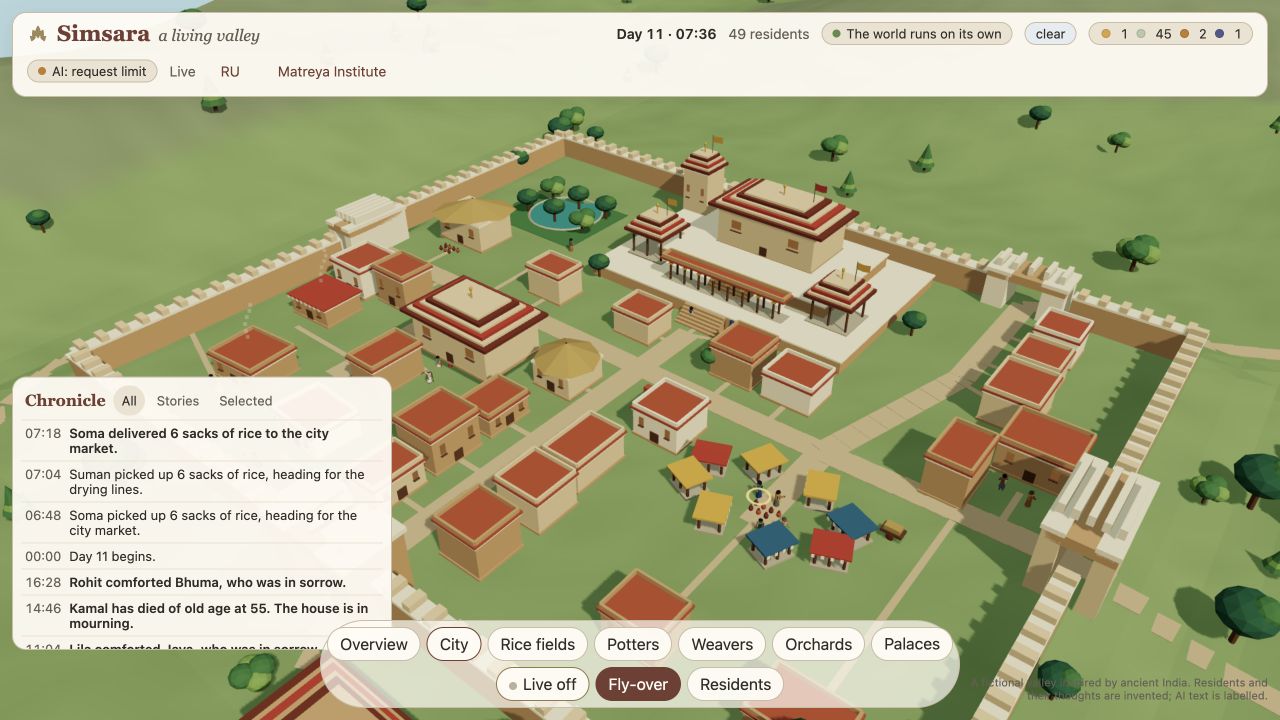
An experimental simulation inspired by ancient India. Observe fictional inhabitants, their daily activities, conversations and memories.

Research project →

Programme 02 · Research question

The universe as a Buddhist neural network?

Status: A question, not a conclusion · mapping stage

The universe knows nothing about Buddhism. Buddhism may know a great deal about it.

Our working hypothesis: some features of how reality is organised — interdependence, the absence of fixed essence, causality and the absence of a permanent self — may be described by Buddhist categories more precisely than is usually assumed. Dependent origination describes every phenomenon as arising from conditions [1], much as the state of a network arises from its connections rather than from isolated units. Predictive-processing theories describe the brain as a system that keeps updating its expectations about the world [2].

Tasks

  • Build a map of correspondences between Buddhist concepts and contemporary models: neural networks, predictive processing, quantum physics and information theory.
  • Turn the strongest correspondences into testable questions, each with what would count as evidence against it.
  • Label every item as metaphor, analogy or testable claim, and keep that label visible.
  • Invite physicists, neuroscientists, AI researchers and Buddhist scholars to review the map.

Stages

  1. Correspondence map, first draft — in preparation.
  2. Review by specialists from different disciplines and traditions.
  3. Selected testable questions published together with methods.

Open questions

  • Which correspondences survive once the metaphor is removed?
  • What observation could show that the analogy is wrong?

We do not claim that physics confirms Buddhism or that the universe is literally a computer. Where a parallel is only poetic, we say so. Read our review of Buddhism and quantum physics →

Programme 03 · Texts

Sutras in plain words

Status: Method in design · pilot: one short sutra

Retellings of Buddhist texts — sutras, treatises and books — for a modern reader, without Buddhist terminology, while keeping the meaning intact.

The identity principle

  • Every retelling is placed next to the original or a canonical translation, so anyone can compare them.
  • A table maps each traditional concept to the plain words we chose, with a note wherever meaning is lost.
  • Specialists and the community review each text; corrections are credited.
  • We adapt only sources whose licences allow it: SuttaCentral translations are released under CC0 [3]; 84000 translations do not permit derivative works without permission [4], so we cite them without adapting them.

Stages

  1. Method and terminology table — in preparation.
  2. Pilot: one short sutra, published after review.
  3. A series of texts chosen together with readers.

Open questions

  • How can a retelling stay faithful when a term has no modern equivalent?
  • Which teachers and translators will review the first texts?

Read and take part

Sources

  1. SuttaCentral — SN 12.1 Paṭiccasamuppādasutta: Dependent Origination (tr. Bhikkhu Sujato)
  2. Friston K. The free-energy principle: a unified brain theory? Nature Reviews Neuroscience 11, 127–138 (2010)
  3. SuttaCentral bilara-data: “all translations supported by SuttaCentral must use CC0 licence”
  4. 84000 Terms of Use (draft, 15 May 2026): translations under CC BY-NC-ND 4.0